
A dialogue with NEMO
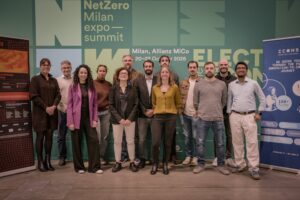
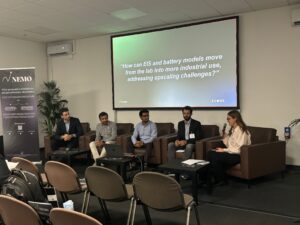
On 20 October, partners from VUB and CEA took part in the final event of the NEMO project with a highly interactive panel discussion that explored how the two projects follow different but complementary approaches to electrochemical impedance spectroscopy (EIS), a non-invasive technique that reveals a battery’s internal state by measuring its response to small electrical signals.
General Assembly: the last stretch towards the digital twin
The dialogue with NEMO carried over into the following day, when the consortium met for the THOR General Assembly on 21 October. The team devoted the whole day to reviewing the next steps of the path that is taking THOR from battery testing to physics-based and AI-enhanced models, and from there to their combination in a battery digital twin with a graphical interface that end users can operate directly.
The models at cell, module and pack level are now on the way to be merged, and the digital twin already supports the first simulations.
Beyond the project: Europe’s race for better batteries
Discussions in Milan also looked beyond the project, at what faster and smarter battery development means for Europe. Global competition is intensifying, and partners agreed that manufacturing capacity alone will not be enough.
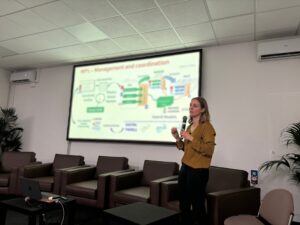
“Digital testing can change the way battery technologies are developed and validated by replacingtime-consuming trial-and-error tests. A huge number of configurations, designs, chemistries and use conditions could be tested virtually, in a few seconds, which is not possible physically” explains Lise Daniel, project manager at CEA and THOR coordinator.
The step from lab to real life remains the hardest. In a car or a storage system, temperature and loadchange constantly, several ageing mechanisms interact, and many key properties sit inside a sealed cell where they cannot be measured directly. For this reason, partners stressed that combining models with real operating data is essential to keep predictions accurate throughout a battery’s life, and that safety assessment and a well-defined duty cycle are crucial to guarantee the required lifetime in industrial applications.
Trust is the other condition. Manufacturers will rely on these tools only with strong evidence that predictions match real-world tests, built on high-quality experimental data and robust, validated models. Common standards will complete the picture.
As battery technologies evolve, better predictive tools can cut testing time and costs, including the number of samples and equipment needed, while adapting to different chemistries, configurations and real-world uses. This is the gap THOR aims to help close.
Follow THOR on LinkedIn and keep an eye on thorbatteries.eu for the public release of the digital twin.